

Post-Tensioned Concrete Explained: How a PT Slab Works, and Why It Still Needs a Pour Strip
How the tendons compress the slab, why a post-tensioned slab shortens elastically and through creep the moment it is stressed, and why that movement is the real reason a PT slab is detailed with a pour strip.
Post-tensioned concrete is usually explained as "tendons that make the slab stronger." The part that actually matters is how much it moves.
If you searched how post-tensioned concrete works, most answers stop at the tendons: steel is stressed after the concrete cures, the slab is held in compression, and it spans farther on a thinner section. That is true, and it is also where the useful part begins. This explainer is written by the engineers whose entire product removes the one detail a post-tensioned slab forces you to leave open, so it goes past the tendons to the mechanism that drives every downstream decision: a post-tensioned slab shortens elastically the instant it is stressed, then keeps shortening through creep, on top of the drying shrinkage every slab has. That is three sources of movement where a reinforced slab has one, and it is the real reason a PT slab is detailed with a pour strip that sits open for weeks. PS=Ø is the ICC Approved, ACI 318 Type 1 and Type 2 compliant mechanical rebar splice, documented under ICC-ES Evaluation Report ESR-4213 and engineered over 45 years, that keeps that movement while taking the open leave-out off the critical path.
What post-tensioned concrete is
Post-tensioned concrete is reinforced concrete, but the steel does a different job. Instead of passive rebar that waits to resist tension until the concrete cracks, a post-tensioned slab is cast around high-strength tendons that are stressed after curing and anchored at the slab edge. Those tendons pull the slab into compression, so the concrete is working against load before any load arrives. That is what lets a PT slab span farther and run thinner than a conventionally reinforced slab of the same capacity.
So the headline benefit is span and thinness. But holding a slab in compression has a physical cost that the span comparison never shows, and it is the reason the rest of this article exists: the same stressing that buys the span also makes the slab shorten, and that shortening has to go somewhere.
How does post-tensioned concrete work?
A post-tensioned slab goes from forms to a compressed, load-carrying deck in a defined sequence. Here is the sequence at a high level, with the step that creates the movement called out, because that step is the one everything else on this page turns on.
- 1
Tendons are placed in the forms
High-strength steel tendons in sheathing are laid out to the engineer of record profile, along with the mild reinforcement, before any concrete is placed.
- 2
The slab is cast and cures
Concrete is placed around the tendons and allowed to reach enough strength to take the stressing force without being damaged by it.
- 3
The tendons are stressed and anchored
A hydraulic jack pulls each tendon to its design force and it is anchored at the slab edge, transferring compression into the concrete. This is the moment the slab shortens elastically, right away.
- 4
The slab keeps shortening for weeks
Under the sustained compression the tendons hold in it, the slab continues to shorten through creep, on top of ordinary drying shrinkage, for weeks after stressing.
Read steps three and four together and you have the whole reason post-tensioned detailing is different. A reinforced slab only has to deal with one of those movements. A PT slab has to deal with all three, and most of it happens in the first weeks. If you want our engineers to read the stressing sequence on a specific layout, call (800) 355-8414.
Why do post-tensioned slabs need a pour strip?
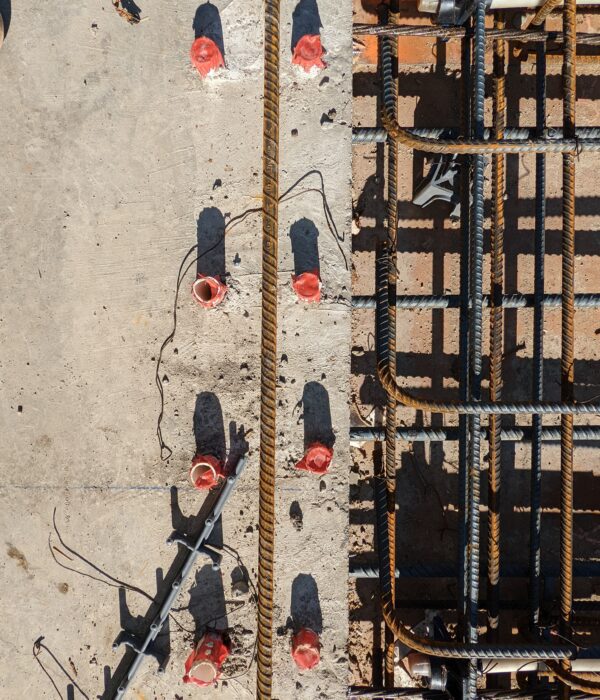
Because a post-tensioned slab moves more than a reinforced one, and it does most of that moving in the first weeks after stressing. A pour strip, also called a delay strip or closure strip, is a gap left open at a construction joint so each side can shorten on its own before the reinforcement is tied continuous. If that shortening is fully restrained by stiff cores, shear walls, or columns, restraint-to-shortening forces build up and crack the slab. Here are the three movements a PT slab has to release at that joint.
| Movement | When it happens | What it is |
|---|---|---|
| Elastic shortening | The instant the tendons are stressed | The jack transfers compression into the slab and the concrete shortens right away, before anyone has walked on it |
| Creep | Over the weeks after stressing | The slab keeps shortening slowly under the sustained compression the tendons hold in it |
| Drying shrinkage | As the slab cures and dries | The same volume change every concrete slab goes through, on top of the two movements that only post-tensioning adds |
"A reinforced slab has to release drying shrinkage. A post-tensioned slab has to release drying shrinkage plus elastic shortening plus creep. Same leave-out on the drawings, far more movement behind it."
That is why a post-tensioned pour strip is left open longer than a reinforced one, commonly cited as 30 to 60 days, so the slab can complete most of its elastic shortening, creep, and drying shrinkage before the gap is cast. The exact window depends on the mix, stressing sequence, span, and how much restraint the engineer of record needs to relieve, so the final number belongs to the design team. For the full side by side, our article on the full post-tensioned vs reinforced comparison walks through where each slab type is used and why the movement differs.
How a continuous mechanical splice removes the open leave-out
The pour strip exists to let the slab shorten, not to interrupt the reinforcement. Once you see it that way, the movement can be kept while the open gap is removed. PS=Ø replaces the open strip with a self-supporting mechanical splice that carries the mild reinforcement across the seam a pour strip would normally interrupt, without touching the tendon layout or the stressing sequence.
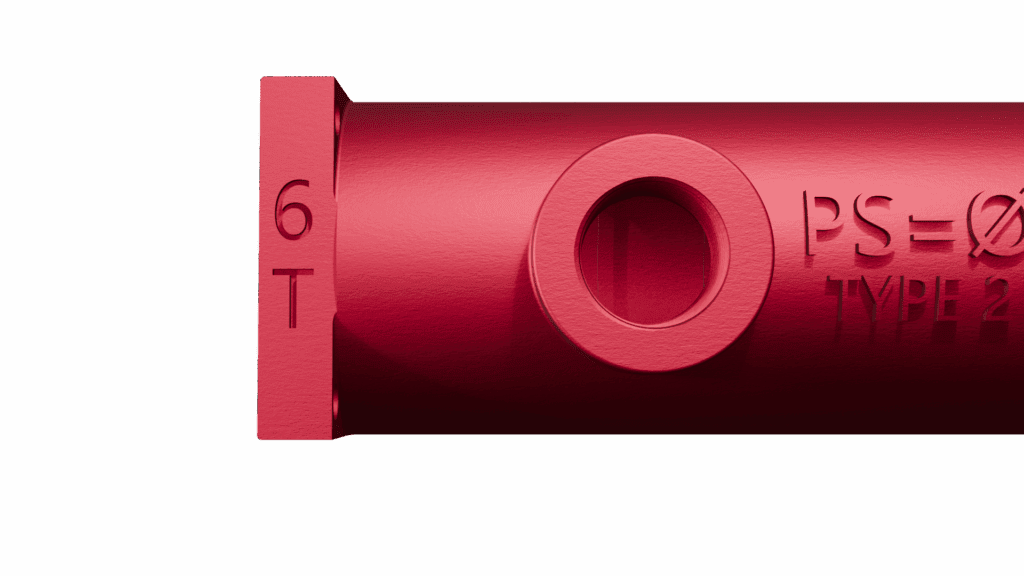
The sequence keeps the PT slab on its own clock. The couplers and closure strip go in exactly where the leave-out would sit. The slab is stressed on the engineer of record schedule and allowed to shorten through elastic shortening, creep, and drying shrinkage on its own timeline. Then, once the shortening is complete, the couplers are grouted to finish a continuous, ICC Approved, ACI 318 Type 1 and Type 2 compliant connection documented under ICC-ES Evaluation Report ESR-4213. The movement still happens. The open gap does not.
Our solution page covers the stressing sequence in depth and shows how PS=Ø eliminates the pour strip in post-tensioned slabs. When you are ready to design a strip out of a specific structure, send us your slab details or call (800) 355-8414.